


How Muslim tradition and modern AI are creating a new form of travel.
ISLAMIC TIMES – Today’s travellers encounter a new generation of artificial intelligence platforms that radically simplify the act of travelling. Mindtrip.ai creates tailor-made itineraries at the touch of a button, including flight details, overview maps and local context.
Layla.ai curates travel ideas, analyses user preferences and generates suggestions in a fraction of a second that would previously have required a professional travel consultant. The technology behind it is impressive: multimodal AI models, real-time interfaces to booking systems, high-quality visual inspiration – all bundled into virtually seamless travel assistants.
But amid this technological perfection, there is a surprising shortcoming: a lack of genuine, in-depth travel ideas. The recommendations often remain interchangeable – lists of popular sights, superficial travel tips and algorithmically filtered hotspots. The platforms can calculate, sort and arrange; what they lack, however, is an idea of why someone travels.
This reveals a fundamental problem: the more powerful technology becomes, the more urgently we need inner orientation. This idea is in close harmony with the statements of German philosopher Markus Gabriel, who emphasises that in the face of the technological revolution, we must deepen our spiritual understanding – otherwise we will lose ourselves in the external world, in the abundance of options, without grasping their meaning.
This tension gives rise to a new insight: travel needs a philosophy. Not as an intellectual luxury, but as a practical compass in the digital age. And this also presents opportunities: a platform that embodies this philosophy could not only inspire travellers but also close a cultural and economic gap.

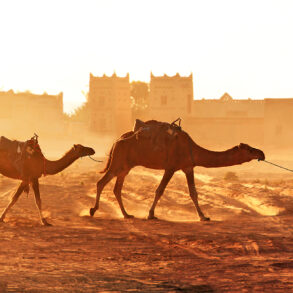
Photo: Christ Troch/Shutterstock
The Muslim tradition of travel: a timeless foundation
Halal travel refers to a form of tourism in which offers are consistently geared towards the religious needs of Muslim travellers. This includes clearly labelled halal food, alcohol-free areas, accommodation with prayer facilities, and information on prayer times and the direction of the Qibla.
Many providers also focus on family-friendly structures and retreats, such as separate wellness or bathing areas, and pay attention to leisure activities that can be enjoyed without religious conflicts. These elements are essential for many Muslim guests because they guarantee safety, comfort and religious compatibility.
But as central as they are to the decision to travel, they do not explain the meaning of travel itself – that human need for encounter, discovery and change that connects people across cultural and religious boundaries.
For Muslim travellers, the question of why we travel is deeply rooted in a tradition that has understood travelling as a path to knowledge for centuries. The Qur’an says: “Travel on the earth and see… .” This does not mean collecting random sights but understanding the signs of the times and the stories of peoples. Our tradition regards travel not only as a worldly necessity, but as a spiritual and intellectual duty. The central theological meaning of travelling (Arabic: Safar or Rihla) lies in contemplation (Tafakkur) and learning lessons (I’tibar) from creation and history.
Before navigation devices and online maps mapped travel, Muslim travellers were chroniclers of world events
Ibn Jubayr, who travelled from Andalusia to Mecca in the 12th century, described cities not only architecturally, but also analysed their social contexts. Ibn Battuta, perhaps the most famous traveller of the Middle Ages, covered more than 120,000 kilometres – on horseback, on foot and by sea.
His view of the world was that of a seeker: countries appeared to him as living tapestries of cultures, languages, customs and encounters. His reports also paint a picture of a wide-ranging network of scholars and personalities from the Islamic world.
The texts of these travellers contain a timeless model: travel as a process of discovery, as responsible exploration, as a silent dialogue between the inner and the outer. Today, it is not a question of romantic retrospection, but of updating these timeless insights – especially in an age when travel experiences are increasingly organised digitally.
In a world where artificial intelligence designs entire journeys before we even pack our suitcases, intention – Niyyah – becomes our compass once again. AI can sort facts, list possibilities, describe landscapes. But it cannot decide what is meaningful. We must learn to ask questions again – before we start searching.
This is precisely where the way Muslim travellers discover their place in the world is changing: not as consumers of distant places, but as mindful observers of a global landscape in search of connections. Modern mass tourism is changing travel destinations worldwide – but how travellers themselves are changing is one of the central questions of a Muslim-influenced travel philosophy.
At the same time, this opens space for innovation: platforms that take intentions seriously can enable new forms of travel. Not ‘where do you want to go?’ but ‘what do you want to understand?’ could become the guiding question.

Photo: Mu2/Shutterstock
The question of technology
Philosophical considerations are necessary to classify the possibilities of technological innovations. Technology is not just an arsenal of machines, algorithms and devices – according to Martin Heidegger, one of the most influential philosophers of European modernism and a representative of phenomenology, it is a certain way of unveiling: a mode in which the world becomes visible, usable and malleable. But it is precisely this power of order, this promise of predictability and control, that reaches its limits when people embark on the open space of travel.
This shows how important European philosophy remains in this context: since ancient times, it has struggled to clarify the relationship between thought, world and experience – between the desire to order reality and the insight that it simultaneously eludes us. Heidegger’s thinking on technology follows this tradition because it draws attention to the fact that every form of knowledge always involves a form of concealment.
The traveller, on the other hand, knows what the technician likes to forget: reality is not an inventory that can be completely measured, optimised or neutralised. It remains stubborn. It emerges, often in contradiction to our plans – in detours, coincidences, encounters and irritations. Those who are on the move experience first-hand that there is no such thing as total availability: changes in the weather, foreign languages, surprising helpfulness or a missed train can say more about the world than any digital map.
The memory that travels holds is therefore this: Technology can structure our relationship with reality, but it does not have the final say. Between plans and experiences, there always remains a residue that cannot be contained. This is precisely where a piece of freedom lies. Reality, as movement through foreign spaces shows, reveals itself not only in smooth access, but in its resistance – in the life of its own that it preserves, beyond all technical availability.
Why a modern philosophy of travel is indispensable today – and how it is emerging
A modern philosophy of travel does not arise intuitively, but from a methodical derivation that is both culturally deep and technologically compatible. Its goal is to gain orientation for the future from the past – and to use this to create a new foundation for travel platforms.
1. Review of Muslim travel literature
Analysis of the works of Muslim travellers across the ages: from early geographers and pilgrim chroniclers to Ibn Jubayr and Ibn Battuta.
2. Comparison with other travel theories
Classification in Far Eastern travel philosophies, European educational journeys of the Enlightenment and indigenous concepts of location-based knowledge.
3. Identifying timeless aspects
Insight, broadening horizons, self-examination, responsibility – the universal elements of travel.
4. A timeless architecture of travel
Synthesis into a spiritual framework that offers orientation beyond cultural boundaries. An approach to knowledge that links technology and philosophy.
5. AI as an amplifier of this architecture
On this basis, AI can:
– Define travel destinations
– Tell narratives
– Develop travel ideas
– Tap into cultural contexts
– Identify trends and global movements
Content-based platforms are not determined solely by mainstream algorithms, but by a curated travel philosophy. Content is designed – not randomly generated. In a global halal travel market that is already worth hundreds of billions of dollars, a new segment is emerging: intelligent, meaning-oriented Muslim tourism.
This is giving rise to a vision: an AI-supported travel platform that not only informs but also inspires – not only shows destinations but also reveals meaning. An approach that is attractive to investors because it is not based on fleeting trends but on structural cultural demand.
“Beyond Tourism”: When a country tries to rethink travel
It is remarkable that one of the most exciting approaches to redefining travel in our time comes from Saudi Arabia – a country where pilgrimage has been the most important form of travel for centuries. The ‘Beyond Tourism’ approach is an innovative initiative launched in November 2025 by the Saudi Arabian Ministry of Tourism in cooperation with the World Economic Forum (WEF).
It was developed as part of the TOURISE25 conference in Riyadh and aims to transform the global travel and tourism (T&T) sector from a fragmented, purely economically oriented model to a holistic ecosystem. Instead of viewing tourism in isolation, the approach integrates adjacent areas such as infrastructure, technology and community development to promote sustainable growth, inclusion and resilience.
The underlying WEF report, Beyond Tourism: Coordinated Pathways to Inclusive Prosperity, provides the theoretical framework and practical pathways for this transformation. In Saudi Arabia, this approach fits seamlessly into Vision 2030, which positions tourism as key to diversifying the oil-dependent economy – with the goal of generating ten per cent of GDP and 1.6 million jobs by 2030.
Saudi Arabia’s Minister of Tourism Ahmed Al-Khateeb sums it up succinctly: ‘Beyond Tourism underscores the sector’s central role as a bridge between cultures, a means of strengthening communities and a source of opportunity for future generations.’ Travellers around the world now share the idea of more sustainable tourism.
However, cultural policy considerations are at least as important: international tourism contributes to international understanding. ‘Worldviews usually come from people who haven’t seen the world’ – this often-quoted bon mot seems surprisingly relevant in times of digital echo chambers.
Today, travellers have a role to play that goes far beyond recreation. Europeans travelling to the Arab world – or Arabs travelling to Europe – encounter the other not second-hand, but directly: in conversation, in eye contact, in everyday life. Such encounters create an understanding that no algorithmic recommendation can provide.
In social media, on the other hand, the image of a world full of conflict and cultural contrasts dominates. Extreme positions prevail most loudly, while the reality of peaceful, curious, respectful encounters is hardly visible. Consciously designed travel counteracts this distorted image – and reminds us that cultures do not have to clash when people actually get to know each other.

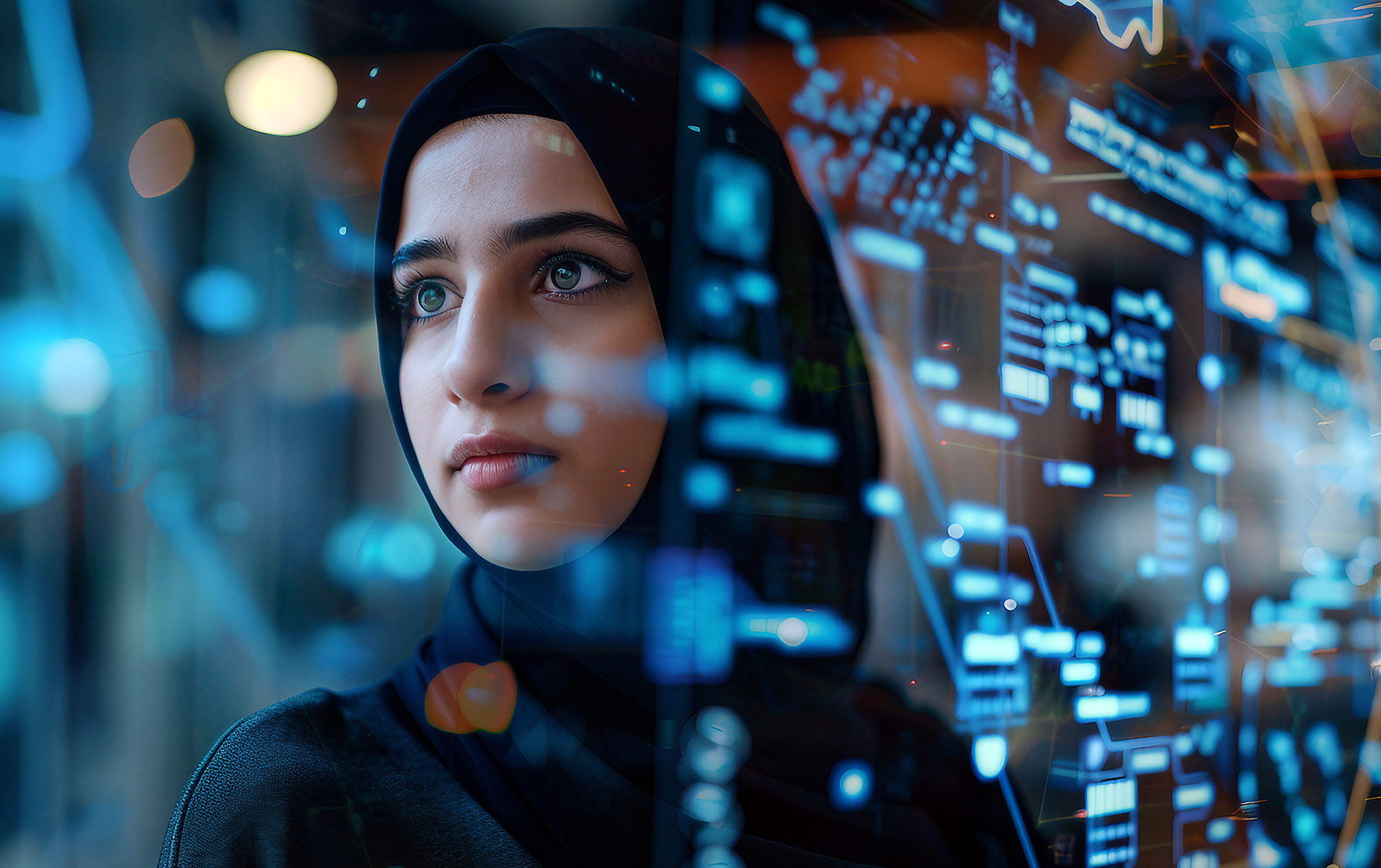
Photo: Andrew Mayovskyy/Adobe
The world map becomes deeper: a new generation of Muslim travel platforms
What would be the result if we combined this travel philosophy with the possibilities of artificial intelligence? If Muslim travellers not only discovered new destinations, but also new perspectives? Then a map opens that is drawn differently. Travellers will always seek relaxation and adventure, but the desire for knowledge and meaning also accompanies travel in the 21st century.
Here are a few examples of such contexts of meaning:
- Islam in Europe – mosques in Sarajevo, villages in Albania, ancient madrasas in the Balkans
- The soul of Andalusia – Mezquita of Córdoba, gardens of the Alhambra, alleys of Seville
- Sicily as a crossroads of civilisations – Arabic geometry, Norman power, Mediterranean lightness
- The ancient routes of knowledge – Timbuktu, Fez, Cairo, Bursa
The possibilities for such trips are almost endless. New-generation platforms are not just booking tools, but dialogical companions that ask: “What do you want to understand?” “Which part of your history do you want to experience?” “Which encounter could change you?” This creates something new: a platform that reveals deep cultural layers – and thus has a unique selling point that is scalable in terms of technology and content.
Travel as a change of perspective
In the end, a clear picture emerges: the future of Muslim travel lies less in new flight routes than in new perspectives: travel as a change of perspective, not just of location. AI can show us the way, and our tradition can provide orientation.
But the direction is decided within us – in the question that underpins everything: what am I really looking for when I travel? Perhaps the answer is the same as it was 800 years ago: we travel to understand – the world, other people and ourselves. And perhaps this is precisely where a new way of travelling begins: not as an escape from everyday life, but as an invitation to delve deeper into the world.